
Design
Start with a problem, sketch, sample, or CAD model. We define the fit, function, material needs, and a design made for additive manufacturing.
- CAD development
- Reverse engineering
- Design-for-additive review
01 Custom CAD + Polymer Manufacturing · Upstate SC
From a worn component, rough sketch, or CAD file to a finished polymer part, without tooling costs or minimum quantities.
[ WHY ADDITIVE ]
Conventional manufacturing makes sense at scale. For one critical bracket, an obsolete cover, or ten custom assembly aids, it often doesn’t. That gap is where we work.
02 One connected workflow
Design decisions and manufacturing realities stay connected from the first measurement to the final component.
Start with a problem, sketch, sample, or CAD model. We define the fit, function, material needs, and a design made for additive manufacturing.

Build and evaluate quickly. We use physical feedback to refine geometry, interfaces, clearances, and usability before production.

Manufacture the validated design as a one-off or short run, with consistent documentation for straightforward repeat orders.
03 Problems we solve
Useful parts do not need to justify a tooling budget. We focus on practical components that remove friction from maintenance, assembly, testing, and production.
Discuss your applicationTask-specific tools that improve repeatability, positioning, inspection, and assembly.
Polymer components that are discontinued, unavailable, or uneconomical to source.
Purpose-built interfaces between equipment, sensors, tools, and existing hardware.
Custom-fit protection and organization for electronics, controls, and mechanisms.
End-use parts in quantities where conventional tooling is difficult to justify.
04 Applications
Every project starts with the operating requirement, not a catalog of machines. These are the kinds of challenges the process is built for.
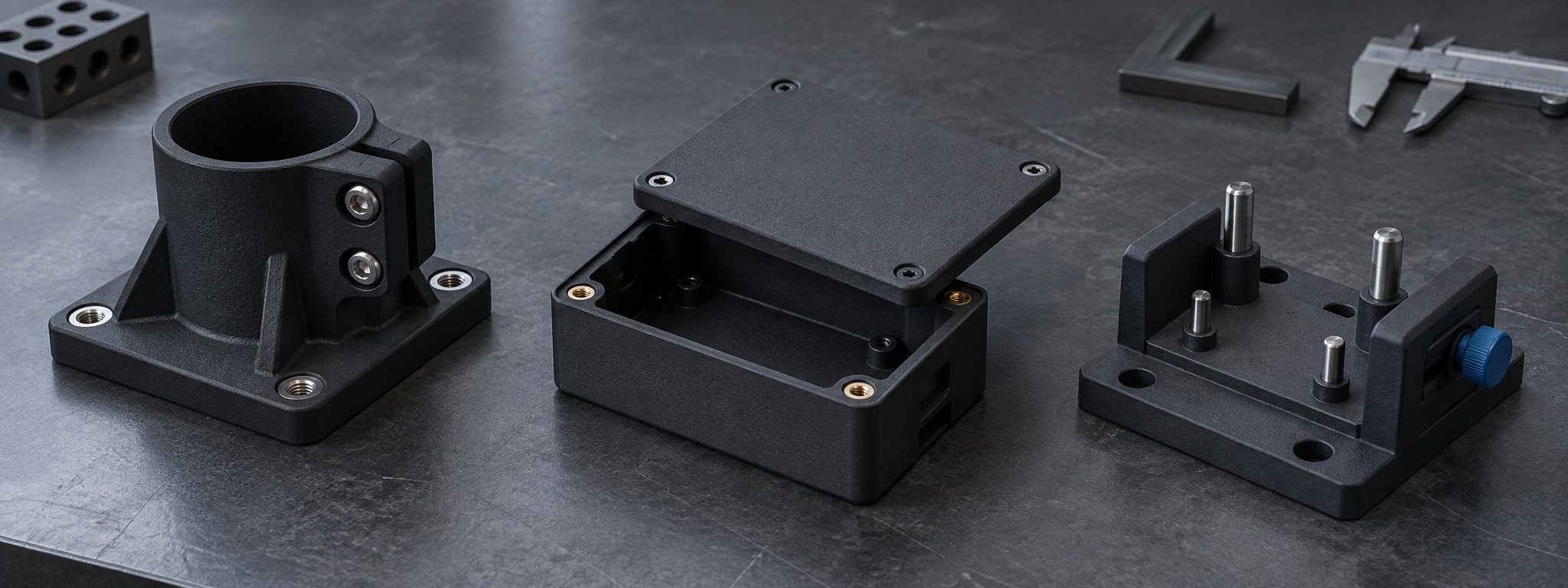
Ergonomic, repeatable tools shaped around your product and process.
Positioning fixtures · Drill guides · Inspection aids · Nests
Recreate unavailable polymer components from a physical sample.
Covers · Knobs · Guides · Guards · Machine components
Test form and function, refine the design, then produce what you need.
Fit checks · Functional prototypes · End-use parts
05 Capabilities
Parts are made on enclosed, hardened-steel FFF printers suited to engineering and fiber-filled materials. If your part falls outside these limits, ask anyway. If another process is the better fit, we will tell you.
Chosen for temperature, impact, chemical exposure, UV, and flexibility. ASA for outdoor and sun exposure, TPU for bumpers, seals, and grips.
Carbon- and glass-fiber-filled grades for stiff, dimensionally stable fixtures and parts that run warm or see wear.
About a 10 in cube in one piece. Larger parts are split and joined with keyed, bonded, or fastened seams.
No minimums. Documented print setups keep repeat orders consistent from batch to batch.
Or a drawing, a dimensioned sketch, photos with a scale reference, or the worn part itself.
Heat-set threaded inserts installed, ready to use. Other hardware can be requested and is reviewed per job.
About 1 week to print from your file. About 2 weeks for design and a first test part. Production quantities are scheduled on the quote.
Greenville, Spartanburg, Anderson, Pickens, and surrounding counties. Customers farther away are welcome, and parts ship anywhere.
06 About the business
Upstate Additive Manufacturing is an independent Upstate South Carolina business focused on practical polymer parts for applications where traditional production tooling does not make sense.
The business is run by Alex McCurley, a Clemson University materials science and engineering graduate with professional experience in aerospace manufacturing and substantial hands-on experience in CAD design and additive manufacturing. That background shapes a disciplined approach to requirements, iteration, material selection, and documentation.
Services include design and manufacturing for polymer components. They are not represented as licensed Professional Engineer services.
07 Common questions
Something not covered here? Call or send a note. A short conversation usually answers it faster.
Nothing. Send what you have and you will get a scoped quote back, usually within 1–3 business days. If the part needs measurement or clarification first, we will say so before any work is billed.
By design time, material, and machine time. Parts that only need printing from your file cost less than parts that need reverse engineering or several prototype rounds. Repeat orders of an existing design are the most economical.
It depends on the job. Printing from a ready-to-print file typically takes about 1 week. Design work through a first test part takes about 2 weeks. Once the test part is approved, the remaining quantity is scheduled on the quote based on part size and count. Timelines start when the quote or design is approved, and review time on your end is not counted. Rush work is available when the schedule allows.
For the right application, yes. Fixtures, guides, covers, mounts, and enclosures are well suited to engineering polymers. Material, print orientation, and wall design are chosen for how the part is loaded. Where a part needs metal, tight machined tolerances, or high volumes, we will recommend that route instead.
Yes. A sample part, even a broken one, is often the best reference. It is measured, modeled in CAD, and checked for fit before production. The model is kept on file, so reorders are quick.
Typical features hold a few tenths of a millimeter. Critical fits such as bores, pin locations, and mating faces are designed with tested clearances, and threaded inserts are added where a durable threaded connection is required.
Yes. Customer designs, drawings, and samples are treated as confidential, and a mutual NDA can be in place before any files are shared.
08 Start a project
Send a few details and whatever you have: photos, measurements, a sketch, a sample part, or an existing CAD file. Expect a response within 1–3 business days.